The Bhutan National Democratic Party (BNDP) has been leading efforts to find a peaceful solution to the Bhutanese refugee issue in Nepal for over three decades since it was founded on February 7, 1992. BNDP remains committed to continuing this effort until a fair and lasting solution is reached, with a focus on durable solutions for the remaining refugees in Nepal and displaced Bhutanese in India.
There are about 6,500 refugees still living in camps in Nepal, and an estimated 12,000 displaced Bhutanese living in different parts of India, including West Bengal, Assam, Arunachal Pradesh, Sikkim, and other northeastern states. Refugees in Nepal have identity cards issued by the Nepal government. Many depend on support from charities or help from resettled Bhutanese communities, especially their relatives. Those living in India likely have some form of local identification that allows them to work and survive. Their option to return to Bhutan is supported by the Indo-Bhutan Friendship Treaty of 1949, which allows Bhutanese people to live, work, own property, and do business in India.
Since 2008, about 113,000 Bhutanese refugees have been resettled in countries such as the United States, Canada, Australia, New Zealand, Denmark, the Netherlands, and the United Kingdom. They accepted resettlement because there was no immediate hope of returning to Bhutan. The international community recognizes Bhutan as their country of origin, and Bhutan has also accepted this in principle. Recently, Bhutan allowed deported Bhutanese individuals from the United States to return, which supports this position. This evolving context indicated resettled Bhutanese population to consider collective platforms, such as the Non-Resident Bhutanese (NRB) to reconnect with their homeland, Bhutan.
It is recognized that the resettled Bhutanese community holds diverse views. Some individuals have the financial capacity and may wish to invest and conduct business in Nepal and India through legal and recognized frameworks such as Non-Resident Nepali (NRN) or Non-Resident Indian (NRI), while also maintaining cultural and social ties. Countries in the region should take practical steps to support these efforts for economic and social engagement.When the idea of the Non-Resident Bhutanese (NRB) platform was introduced in 2009, the Bhutan National Democratic Party (BNDP) consulted political leaders in Nepal and India, as well as Bhutanese leaders, including Dasho Rongthong Kunley Dorji, President of the Druk National Congress (DNC), and Dasho Tek Nath Rizal. The late Rongthong Kunley Dorji strongly supported the idea. He saw it as an opportunity to bring together all Bhutanese living abroad, whether born in Bhutan or in refugee camps, into one platform. Over time, this could become a meaningful organization supporting the welfare of Bhutan and its people. It could also serve as a long-term solution for resettled Bhutanese, which Nepal and Bhutan would need to consider when finalizing their agreements toward a permanent resolution of this issue.
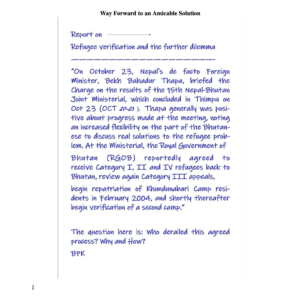
Now may be the time to move beyond the long and difficult history of the Bhutanese refugee issue and focus on new ideas and future solutions. The concept of a NRB platform becomes especially relevant once the situation of refugees in the Bhutanese refugee camps is resolved. Bhutan and Nepal missed a major opportunity to fully resolve this issue in 2003, following disputes related to the Bhutan Joint Verification Team at the Khudunabari camp.
The first logical step is the repatriation of refugees in Nepal who are willing to return. Only after that can we clearly explore options for resettled communities, such as NRB, NRN, or NRI, through a proper process involving Bhutan, Nepal, and India. The idea of NRB was introduced to emphasize that supporting family reunification and enabling resettled Bhutanese to reconnect with their historical and cultural roots is a shared responsibility of Bhutan and Nepal, alongside resolving the situation of refugees still in the camps.